
When someone you love begins needing more help with everyday life, figuring out what comes next can feel overwhelming.
You may know that Mom needs some assistance getting ready in the morning, or that Dad isn't managing quite as well at home as he used to. But knowing they need a little extra support and knowing what kind of support they need are two very different things.
Assisted living, nursing homes, and in-home care are often mentioned in the same conversations, but they aren't interchangeable. Each provides a different level of support, and understanding those differences can make the decision-making process much easier.
Whether you're just beginning to explore senior care options in Wisconsin or actively looking for assisted living near Lake Mills, here's what families should know.
Understanding Your Senior Care Options
Before comparing individual communities or care providers, it helps to understand the three main options.
Assisted living provides a residential setting with help for everyday activities, such as bathing, dressing, meals, and medication assistance, depending on the community.
Nursing homes provide residential care for individuals who need more extensive nursing services and ongoing medical support.
In-home care allows someone to remain in their own home while receiving assistance from caregivers who visit on an agreed schedule.
None of these options is automatically better than another. The right choice depends on someone's health, safety, preferences, independence, and the amount of support they need.
Let's look a little closer.
What Is Assisted Living?
Assisted living is designed for people who value their independence but would benefit from regular support with certain parts of daily life.
Perhaps getting dressed has become difficult, preparing meals feels exhausting, or remembering medications has become a concern. Maybe someone is physically doing fairly well but spends most of their days alone and would enjoy more opportunities for connection.
Assisted living offers a middle ground between living completely independently and receiving more intensive medical care.
What Services Does Assisted Living Typically Provide?
Services vary between communities, but may include:
Assistance with bathing, dressing, grooming, and other personal care
Medication management or assistance
Prepared meals and snacks
Housekeeping and laundry
Scheduled activities and opportunities to socialize
Assistance with mobility and everyday routines
Staff support and emergency response procedures
Individualized care planning
An important distinction is that assisted living generally focuses on supporting daily life, rather than providing the same level of continuous skilled nursing care found in a nursing home.
Who Is Assisted Living Best For?
Assisted living may be a good fit for someone who:
Needs help with certain everyday tasks
Has difficulty managing medications independently
Would benefit from meals and household responsibilities being handled
Feels isolated or lonely at home
Needs more consistent access to assistance
Wants to maintain independence without managing an entire household
One of the biggest misconceptions about assisted living is that moving into a community means giving up independence.
In reality, the goal should be to preserve as much independence as possible while providing support where it's needed.
Someone may still be perfectly capable of choosing their daily routine, participating in hobbies, spending time with family, and making decisions about their own life. They simply have help available for the things that have become more difficult.
What Is a Nursing Home?
A nursing home, sometimes called a skilled nursing facility, provides a higher level of nursing and medical care than most assisted living communities.
Nursing homes serve people whose health conditions or care needs require more extensive professional support.
For example, someone recovering from a major illness or surgery may need short-term skilled nursing and rehabilitation. Another person may have complex medical needs that require long-term nursing home care.
What Services Do Nursing Homes Typically Provide?
Depending on the facility and individual needs, services may include:
24-hour nursing care
Medication administration and medical monitoring
Assistance with daily personal care
Rehabilitation services, such as physical, occupational, or speech therapy
Wound care and other skilled nursing treatments
Support for complex or ongoing medical conditions
Meals, housekeeping, and personal assistance
Not every nursing home provides every specialized service, so families should always confirm what is available.
Who Might Need Nursing Home Care?
Nursing home care may be appropriate when someone has medical or functional needs that cannot safely be met through assisted living or scheduled in-home assistance.
This could include individuals who need frequent skilled nursing interventions, substantial physical assistance, or specialized care for complex health conditions.
The distinction isn't simply someone's age or diagnosis.
It's the type, frequency, and complexity of the care they require.
What Is In-Home Care?
In-home care allows an older adult to remain in their current home while receiving help from a caregiver.
For many families, this is the first option they explore, particularly when their loved one is strongly attached to their home and only needs assistance with a few things.
In-home care can be very flexible, ranging from a few hours per week to more extensive daily support.
However, it's important to distinguish between nonmedical home care and home health care.
Nonmedical In-Home Care
Nonmedical caregivers may assist with:
Bathing and dressing
Meal preparation
Light housekeeping
Grocery shopping and errands
Companionship
Transportation
Everyday routines
Home Health Care
Home health care involves medical services delivered in the home by qualified healthcare professionals.
These services may include nursing visits, physical therapy, occupational therapy, and other medically necessary treatments.
Home health services are often ordered by a healthcare provider and may be provided for a specific period.
Who Is In-Home Care Best For?
In-home care may be a good fit when someone:
Wants to remain in their current home
Needs help for a limited number of hours
Has a safe and accessible home environment
Has family or other support available when caregivers aren't present
Does not need continuous supervision or extensive residential support
The biggest consideration is whether the amount of care available at home truly matches the person's needs.
A caregiver visiting for three hours each morning can provide valuable help, but that doesn't necessarily address concerns that arise overnight or throughout the rest of the day.
Assisted Living vs. Nursing Home vs. In-Home Care: A Side-by-Side Comparison
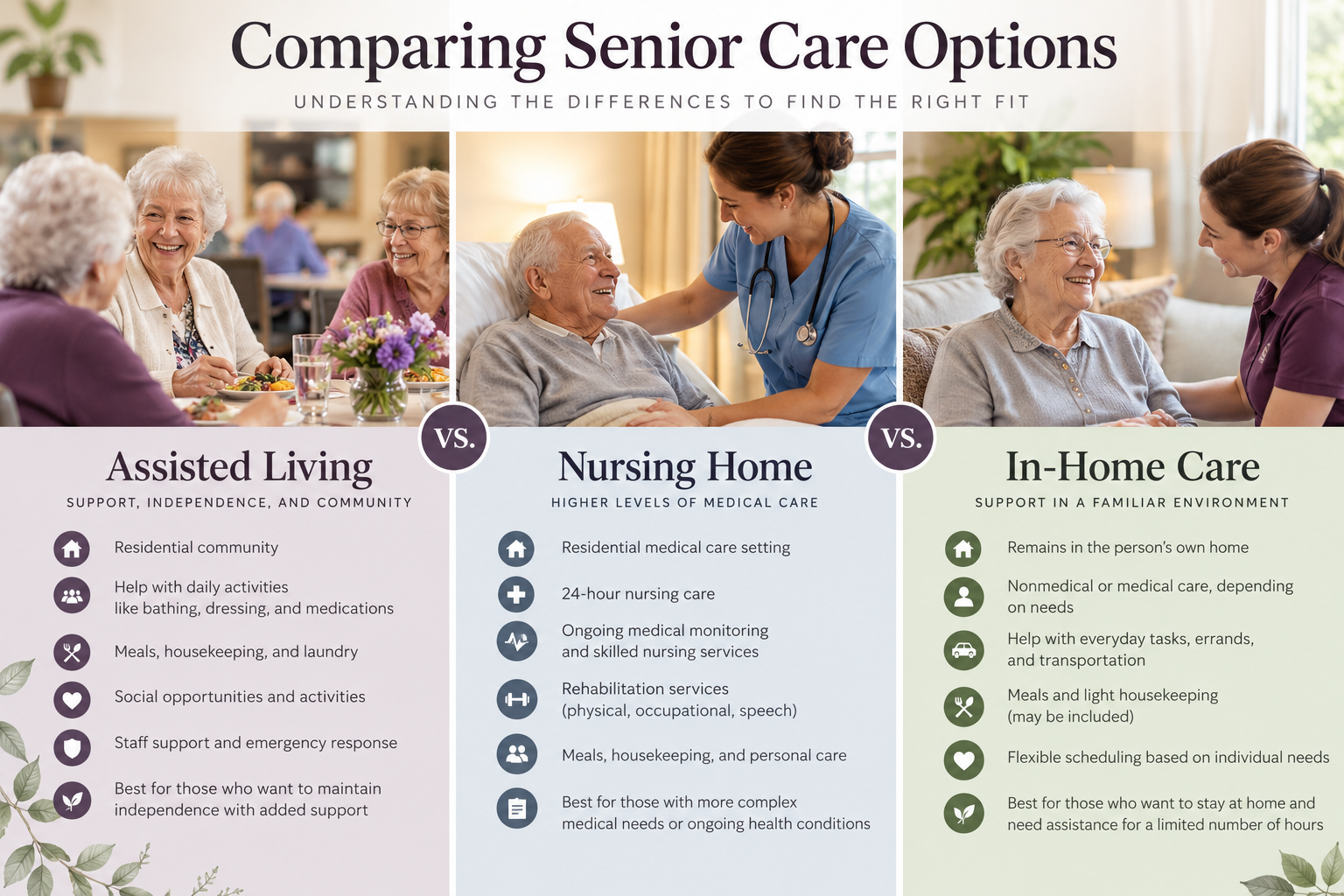
** Every provider is different, so use this as a starting point rather than assuming that all communities or agencies offer identical services. **
How Much Does Each Type of Senior Care Cost?
Cost is understandably one of the biggest questions families have when comparing senior care options.
Unfortunately, there's no single answer that applies to everyone.
The cost of assisted living, nursing home care, or in-home care depends on factors such as location, the amount of assistance needed, room type, services included, and the provider.
Assisted Living Costs
Assisted living communities may charge a monthly rate that includes housing, meals, and certain services, with additional charges based on care needs or other options.
When comparing communities, ask for a complete explanation of what is included and what could cause the monthly cost to change.
Nursing Home Costs
Nursing home care is often more expensive because of the greater level of medical and nursing support provided.
Payment arrangements may involve private funds, long-term care insurance, Medicaid for eligible individuals and facilities, or limited Medicare coverage for qualifying short-term skilled care.
In-Home Care Costs
In-home care is commonly billed by the hour.
When someone only needs a few hours of assistance each week, it may be more affordable than residential care.
However, when care needs increase to many hours per day or overnight support, costs can rise considerably.
Families should also consider the ongoing expenses of maintaining a home, including utilities, groceries, taxes, insurance, and repairs.
Does Medicare Pay for Assisted Living?
Generally, Medicare does not cover the cost of living in an assisted living community or long-term custodial care.
Medicare may cover certain medically necessary healthcare services for eligible individuals, but it does not ordinarily pay for room, board, or routine personal assistance in assisted living.
Medicaid coverage and eligibility vary by state and program.
In Wisconsin, programs such as Family Care may help eligible individuals access certain long-term care services, depending on their circumstances and the provider's participation.
It's always worth asking a prospective community which payment options and programs it accepts.
How Do You Know Which Senior Care Option Is Right?
Rather than beginning with the question, "Which type of facility should we choose?" it can help to start with a few simpler questions.
How Much Help Is Needed Each Day?
Does your loved one need occasional assistance with errands and cleaning? Or do they need help with dressing, bathing, medications, meals, and other activities throughout the day?
The frequency of assistance can be just as important as the tasks themselves.
Are There Medical Needs That Require Skilled Nursing?
Someone with complex medical needs may require services beyond what an assisted living community or nonmedical home caregiver can provide.
A healthcare professional can help determine whether skilled nursing or another level of care is appropriate.
Is Their Current Home Still a Good Fit?
Consider accessibility, stairs, bathroom safety, fall risks, maintenance responsibilities, and the availability of help during an emergency.
Sometimes a home that worked beautifully for decades no longer supports someone's changing needs.
How Important Is Social Connection?
Someone may be physically capable of remaining at home but have very few opportunities for companionship.
Shared meals, activities, and everyday conversation can be meaningful considerations when comparing residential care with remaining at home.
What Does Your Loved One Want?
This question deserves just as much attention as the others.
Whenever possible, involve your loved one in the conversation.
Their preferences, concerns, routines, and sense of independence should be part of the decision.
The best care arrangement isn't simply the one that meets a list of needs. It's the one that supports the person as a whole.
Why Some Families Prefer Smaller Assisted Living Communities
When families begin touring assisted living communities, they often focus on services, amenities, and cost.
Those things matter, but the size and atmosphere of a community can also influence the experience.
Some individuals enjoy the variety and scale of a larger community. Others feel more comfortable in a smaller, more familiar environment.
A smaller assisted living setting may offer opportunities for:
More familiar faces and daily routines
Personal relationships between residents and caregivers
An atmosphere that feels closer to home
Care that reflects individual preferences
More personal communication with families
Of course, community size alone doesn't guarantee better care. Staffing, training, leadership, communication, and the quality of services all matter.
The key is finding a place where your loved one feels comfortable, respected, and supported.
Exploring Assisted Living in Lake Mills, Wisconsin
At Lilac Springs Assisted Living in Lake Mills, WI, we believe that choosing senior care should begin with understanding the individual.
Our philosophy, Better Care, Not Bigger Numbers, reflects our commitment to a smaller, more personal approach to assisted living.
With a 24-resident community, our focus is on getting to know the people who call Lilac Springs home: their personalities, routines, preferences, and the things that matter most to them.
We understand that families researching assisted living in Lake Mills, Jefferson County, and surrounding Wisconsin communities may be navigating this process for the very first time.
And we know there are a lot of questions.
What level of assistance is appropriate? What happens when care needs change? How will a loved one adjust to a new environment?
Those are important conversations, and they deserve thoughtful answers.
If you're exploring assisted living for someone you love, we welcome you to learn more about Lilac Springs, ask questions, and see whether our community may be a good fit.
You don't have to have everything figured out before starting the conversation.
Explore Care & Services at Lilac Spring
Contact Lilac Springs to Schedule a Visit
Frequently Asked Questions About Senior Care Options
Is assisted living the same as a nursing home?
No. Assisted living generally provides housing and support with everyday activities while encouraging independence. Nursing homes provide a higher level of ongoing nursing and medical care for individuals with more complex needs.
Can someone move from in-home care to assisted living?
Yes. Many families begin with in-home assistance and later explore assisted living when their loved one's needs change or when managing care at home becomes difficult.
Does assisted living provide 24-hour care?
Assisted living communities may have staff available around the clock, but the level of care and staffing varies. Having staff on-site 24 hours a day is not the same as providing continuous one-on-one care or 24-hour skilled nursing. Always ask a community about its specific staffing and services.
Is assisted living less expensive than a nursing home?
Assisted living is often less expensive than nursing home care, but actual costs vary based on location, services, and individual care needs. Comparing written estimates from providers is the best way to understand the financial differences.
Can assisted living residents still make their own decisions?
Yes. Assisted living should support residents' independence and personal choices as much as possible. Residents can generally continue making decisions about their routines, activities, relationships, and preferences, subject to their individual circumstances and care needs.
What senior care options are available near Lake Mills, WI?
Families in Lake Mills and surrounding Jefferson County communities can explore assisted living, in-home caregiving, home health services, and nursing home care. The appropriate choice depends on individual needs, medical requirements, preferences, and available services.
